Sub-Total: $0.00
Unmasking the All father: Odin Before the New Age Lens
The name Odin resonates with power, poetry, and war. Yet, in modern spirituality, the complex, often contradictory figure of the All father has frequently been softened, simplified, or misunderstood. To truly connect with the “real” Odin of the pre-Christian Norse world is to face a god who is simultaneously inspiring and terrifying, a master of paradox, and a deity whose relentless pursuit of wisdom demanded the highest price: sacrifice and suffering.
Your individual relationship with Odin is, and should be, unique. He is not a one-size-fits-all patron. He is the master of transformation, chaos, and ecstasy, meeting each seeker where they are on their path of knowledge and power.
The Male God of “Woman’s Magick”: Seiðr and Ergi
One of the most striking paradoxes of Odin is his mastery of a form of Old Norse magic called Seiðr.
- The Magick of Seiðr: Seiðr was a type of sorcery primarily practiced by women (völur or seiðkonur). It involved prophecy, divination, altering fate, and often entering ecstatic, trance-like states. It was deeply connected to the concept of fate (Ørlög and Wyrd), which was symbolically “woven” by the Norns.
- The Shame of Ergi: For a man (seiðmaðr) to practice Seiðr was to court the insult of ergi, a profound accusation of unmanliness, effeminacy, or deviance from the masculine ideal of forthright, open conduct. A true Viking warrior was expected to meet his fate openly, not manipulate it through subtle, feminine means.
- Odin’s Transgression and Power: Odin, the ultimate Warrior-King, shamelessly practices Seiðr, a fact Loki throws in his face in the poem Lokasenna. This demonstrates Odin’s willingness to transgress cultural boundaries and sacrifice social standing—even his reputation for manliness—to gain a crucial form of cosmic power and knowledge. He is the quintessential boundary-crosser, valuing esoteric might above all else, even honour in the eyes of men.
The Nuance of Sex Magick
While the idea of Odin being the “first to practice sex magick” is often a modern spiritual interpretation, it finds its root in the gendered nature of Seiðr and the suggestion that some of the practices, potentially involving ritual staves with phallic epithets, may have had sexual components to achieve the ecstatic states necessary for deep prophecy or manipulation of fate.
The core takeaway, however, is not a literal description of a specific sex act, but that Odin was willing to embrace roles and energies considered taboo for a male god—including the feminine, ecstatic, and perhaps erotic aspects of power—to serve his relentless ambition for knowledge.
The God of Sacrifice and Suffering for Wisdom
Odin’s defining characteristic is his insatiable, punishing thirst for wisdom. He is a god defined by his willingness to pay the ultimate price.
- The Eye in Mímir’s Well: To gain a single, profound drink from Mímir’s Well, the source of ultimate wisdom, Odin sacrificed one of his eyes. He traded common, physical perception for a higher, esoteric, and cosmic understanding. His one-eyed appearance is the permanent, visible mark of his devotion to knowledge.
- The Self-Sacrifice of the Runes: His most famous sacrifice is recounted in the Hávamál. To discover the runes, the sacred knowledge and cosmic truths, he endured a ritual death:
“I know that I hung on the wind-swept tree Nine long nights, Wounded with a spear, and given to Óðinn, Myself to myself,”
He was the offering, the priest, and the recipient all at once. He was hanged on Yggdrasil, the World Tree, pierced by his own spear, Gungnir, for nine days and nights, suffering cold, hunger, and the agony of the suspended dead. This ordeal was a journey to the realm of the dead and back, a profound shamanic experience that granted him the power and knowledge of the runes.
- Suffering as Currency: Odin teaches that there is no cheap wisdom. Suffering, risk, and profound personal sacrifice are the currency of true insight. He is a harsh god because the lessons he delivers are born of fire and death.
The God of Many Names and the Hanged Man
Odin’s plethora of names, or heiti and kennings, is not merely a stylistic quirk—it speaks to his multifaceted, shape-shifting nature and his need for disguise.
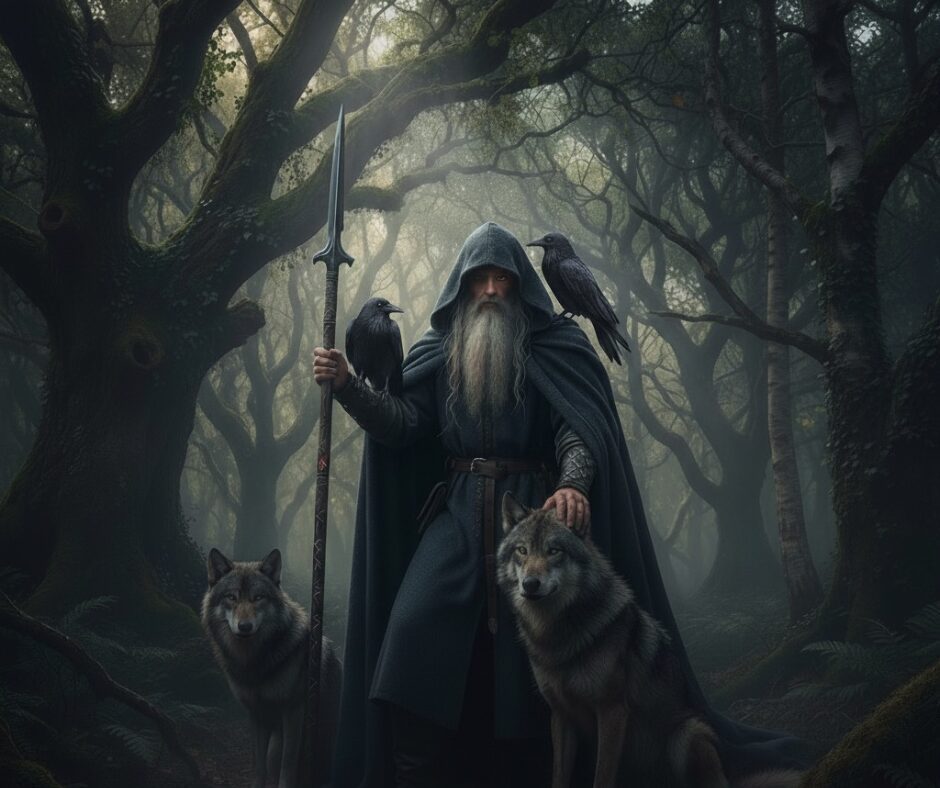
- The Masked God: Names like Grímnir (the Masked One), Síðhöttr (Broad-Hat, referring to his disguise as a wanderer), Bölverkr (Evil-Doer), Yggr (The Terrible), and Alföðr (All-Father) reflect his different roles: the seeker, the war-god, the trickster (though a harsh one, not a playful one), and the patriarch. He constantly adopts disguises—often as an aged, cloaked wanderer—to move unnoticed through the world of men and gods, testing loyalties and subtly influencing fate.
- The Hanged Man: This connection is direct and powerful. Odin hanging himself on Yggdrasil, wounded by his spear, is the literal mythological source for the Hanged Man (Tarot Major Arcana XII). The card represents willing suspension, sacrifice, and seeing the world from a completely inverted perspective to gain a higher understanding. It is a moment of stasis, not surrender, where the world is turned upside down to access new knowledge. This perfectly encapsulates Odin’s self-immolation for the sake of the Runes.
“Father of Many”—Beyond Biology
Odin is often called Alföðr (“All-Father”) and Valföðr (“Father of the Slain”), but the phrase “Father of Many” suggests more than his biological role as the progenitor of many gods (including Thor, Baldr, and Týr) and, in some traditions, of the first humans (Ask and Embla).
- Father of Inspiration (Óðr): The Old Norse root of his name, Óðr, means “frenzy,” “ecstasy,” or “divine inspiration.” In this sense, he is the Father of Inspiration, the force that drives poets, berserkers, and shamans into a state of sacred madness to achieve their greatness. He is the source of all artistic and martial genius.
- Father of the Slain (Valföðr): As Valföðr, he is the father who chooses and gathers the most heroic of the fallen warriors (Einherjar) to his hall, Valhalla. He is the father who cultivates and prepares the very best for the final, great battle of Ragnarök. In this light, his “children” are those he has chosen, guided, and claimed in death.
Odin is not an easy god. His service is demanding, his lessons harsh, and his presence often unsettling. To approach him is to embrace the paradox—the King who practices ergi, the Wise One who self-mutilates, and the All-Father whose greatest lesson is the value of facing personal suffering head-on for the sake of truth.
Our Father, who art in Asgard, Hallowed be your name, Alföðr (Allfather).
Your Will be done, In Midgard as it is in the realms above.
May the lessons of Ragnarök guide our actions.
Give us this day our knowledge of the runes,
And the clarity to speak the truth.
Forgive us the blindness of the fool,
As we strive to forgive those who remain ignorant.
Lead us not into soft comfort,
But deliver us from weakness and fear.
For Yours is the wisdom, the sacrifice, and the power,
In the Nine Worlds, now and forever.
Hail.